CELA at Wintertuin Festival Nijmegen – by Lena van Tijen (translator SB – NL)
The meet-up at the Wintertuin Festival in Nijmegen, from 24 to 25 November 2025, was the second gathering for the Dutch-Flemish group of translators during the CELA festival tour. The first one took place at the Passa Porta Festival in Brussels back in March. In that sense, we are a privileged group, seeing each other and participating in not one but two Translation Cafés over a relatively short period of time.
The difference between our first panel discussion in Brussels and this one was, at least for me, quite apparent. Not only did we clearly know each other better, both personally and professionally, we also seemed to have developed a stronger sense of who we are as translators in only a few short months.
Before I describe what Wintertuin meant for us as translators, I want to say something about the festival in a more general way. Wintertuin has been a literary staple in the Netherlands for the past thirty years. The theme of this year’s edition was Tijdgenoten, translated as Contemporaries, and its main venue was LUX cinema and theatre in the centre of the city. The festival hosted major international authors such as the French writer Édouard Louis, who came to discuss his new novel L’effondrement, translated into Dutch as De ondergang by Kiki Coumans. It also welcomed Dutch author Joost de Vries, who opened the festival’s Industry Day for professionals, and writer in residence Safae el Khannoussi.
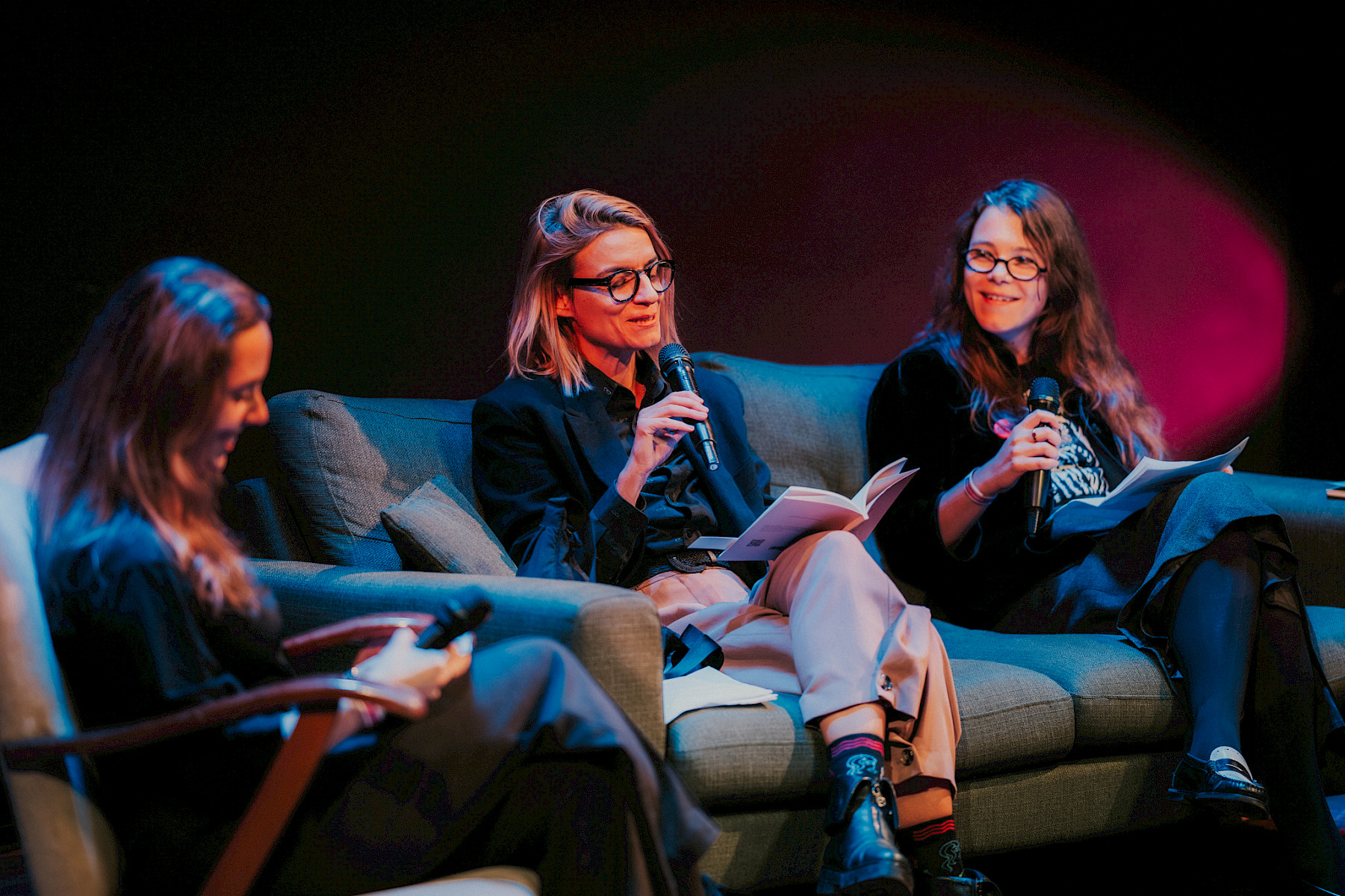
CELA was present throughout the festival. During the Industry Day on Friday 28 November we hosted a Translation Café with two short discussions led by translator Manon Smits. On Saturday 29 November, CELA participants also contributed to the public events with three interviews, a performance and a poetry reading. The interviews were: Uprooted Voices, with Serbian writer Ljiljana D. Ćuk and me, her translator Lena van Tijen, in conversation with CELA author Hanan Faour; Language for Femicide, with Italian author Valeria Usala, her translator Leine Meeus and Dutch author Tessel ten Zweege; and a conversation with Ukrainian writer Andriy Lyubka and his translator Roman Nesterenco. The day also featured The Nine Months Revolution, a performance by Spanish writer Yaiza Berrocal and her translator Lies Doms, and a poetry reading by Romanian poet Anastasia Gavrilovic and her translator Charlotte van Rooden.
Although Lyubka and Gavrilovic are not CELA authors, their translators, Nesterenco and Van Rooden, made sure their voices were heard during the festival. This illustrates the position of the translator at Wintertuin. In every CELA-related appearance the translator was explicitly present and stood on stage alongside the author. Their presence amplified the author’s voice and sometimes offered a contrasting perspective.
In the Netherlands translators are receiving increasing recognition for their work. One example is the growing practice of placing the translator’s name on the cover of books. Wintertuin reflects and strengthens this development. The festival makes clear that the translator is not invisible but integral, valued and unmistakably present.
For us, this visibility meant more than simply being acknowledged. It was not only lovely to work closely alongside our authors, but also deeply encouraging to be recognised in our own right. Translators often move between worlds, carrying stories across languages and cultures, yet our work can remain largely unseen. At Wintertuin, our role was treated as essential. This strengthened my colleagues and me and gave us the confidence to make our own voices heard.
Experiences like this matter. When a festival places the translator on stage and in conversation, it highlights the fact that literature is a collaborative art. It reminds audiences that every translated book exists through shared creativity. Being treated as a full partner in that process was meaningful and motivating, and it affirmed our place within the literary field.
Photography by Elske Nissen